

Why is there an EEE Vaccine for Horses but not for Humans?

Actually, there is a human vaccine for eastern equine encephalitis (EEE), but it has never been approved for public use. The U.S. Army Medical Research Institute of Infectious Diseases—the military medical research institute at Fort Detrick in Maryland—developed a human EEE vaccine in the mid-1980s. Tufts Cummings School Professor Sam Telford, an expert on infections spread by mosquitoes and ticks, explains.
Remembering Stuart Levy, a Pioneer Who Sounded the Alarm on the Threat of Antimicrobial Resistance
Stuart B. Levy, a key inspiration for CIMAR and an Emeritus Professor of Molecular Biology and Microbiology at the Tufts University School of Medicine, died following an extended illness on September 4th. Dr. Levy’s pioneering research and impassioned advocacy raised awareness of the danger of antibiotic resistance, He was 80. Colleagues, friends and family remember Dr. Levy in this piece from TuftsNow.
ASM Podcast Honors the Life and Legacy of Dr. Stuart Levy
The TWiM holobionts pay tribute to Stuart Levy, and reveal the remarkably diverse array of cyclic nucleotides synthesized by bacteria that likely mediate interactions with animal and plant hosts. Dr. Levy’s friends and colleagues, Drs. Elio Schaechter and Michele Swanson, join the discussion.
Antibiotics Are Losing Their Power Against Deadly Infections. Can We Fix the Problem?
Experts say the problem of AMR is compounded by improper use of antibiotics by doctors, hospitals and patients, as well as by farmers and others in the agricultural sector (the drugs are commonly administered to livestock, as well as to humans). Check out this eye-opening panel discussion from CIMAR’s Dr. Helen Boucher and others.
CIMAR LEAP Fellow Presents Groundbreaking Antimicrobial Stewardship Findings at IDWeek
October 15, 2019
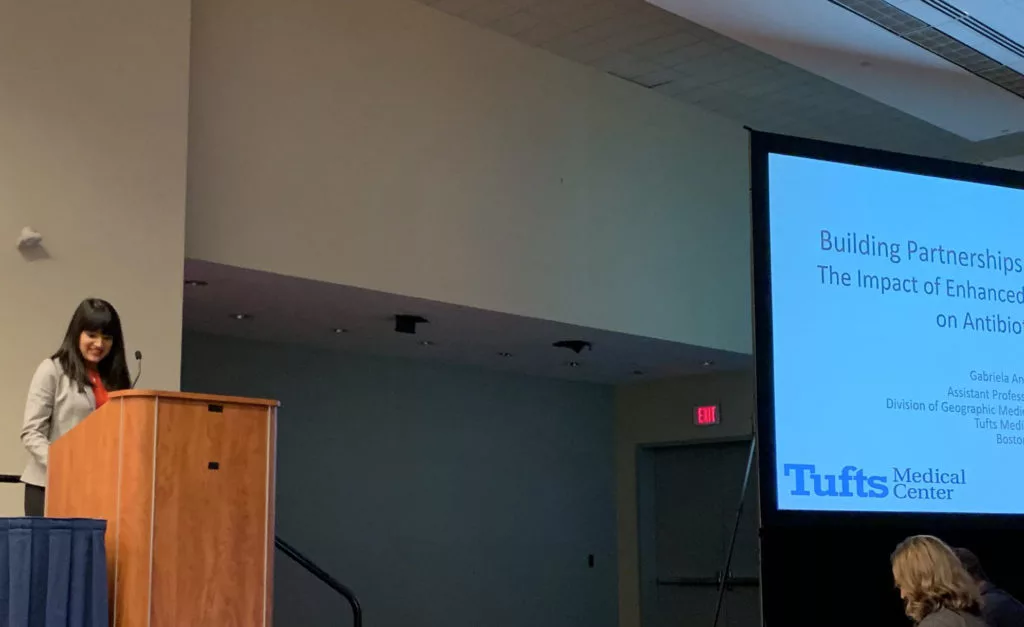
Dr. Gabriela Andujar Vazquez presented groundbreaking findings from her antimicrobial stewardship pilot study at IDWeek in Washington, D.C. earlier this month. The study showed a 20% decrease in antibiotic start rate in patients, potentially demonstrating the benefit of enhanced stewardship support by an expert on antibiotic use in long term care.
Is the Gene-Editing Tool, Crispr, the Next Antibiotic?
Desperate to find new medicines against pathogenic microorganisms, scientists are turning to Crispr, which has typically been considered for macroscopic tasks: altering mosquitoes so they can’t spread malaria, editing tomatoes so they are more flavorful and curing certain genetic diseases in humans. Now researchers are harnessing Crispr to turn a bacterium’s machinery against itself, or against viruses that infect human cells.
Wellcome Trust Report Urges Better Antimicrobial Resistance Messaging
A new report suggests clinicians, public health professionals, and journalists need to rethink the way they talk about antimicrobial resistance to increase public understanding and promote action by policy makers. In this article, CIMAR Director Dr. Helen Boucher acknowledges that while it is challenging issue to explain to the public, stakeholders haven’t done a great job of communicating the immediacy and severity of antimicrobial resistance.
Unlocking Biological Materials for Better Therapies
Researchers at Tufts’ Laboratory for Living Devices (L2D) link materials like silk and paper with technology, medicine, and diagnostics. CIMAR and L2D faculty member, Dr. Bree Aldridge, and her team are using biomaterials made of silk to engineer programmable diagnostic platforms—or petri dishes of the future—to fight antimicrobial resistance by gathering more detailed information about susceptibility to multiple drugs.
New Antibiotics Needed “Yesterday” to Tackle Drug-Resistant Infections, Says CIMAR Director
When Roxana Sudderth’s son, Trey, a healthy high school freshman, developed a sore on his foot after playing basketball, it just looked like a small blister. Doctors gave him antibiotics, but the pain persisted. Sudderth took him to the hospital where they told her he had a life-threatening infection, MRSA, a bacterium resistant to antibiotics. Over 19 days, his condition deteriorated until finally doctors told Sudderth it was time to take Trey off life support.
‘Superbug’ Infections are on the Rise, a New CDC Report Says
We see people from everyday life, who are young and otherwise healthy, who get a MRSA \\[methicillin-resistant Staphylococcus aureus\\] infection on their skin, says CIMAR Director Dr. Helen Boucher. We want to have diagnostic tools and medical treatments for problems we know we’re going to have, she said. But we also need to prepare for the kind of resistance that we could never predict. We know from history that bacteria and mother nature are smarter than we are.
- Tufts Researchers Find Link Between Dog-Human Antibiotic Resistance
- IDSA announces Tufts Medical Center Among Recipients of Antimicrobial Stewardship Centers of Excellence Designation
- CIMAR Featured in Spotlight on Research and Collaboration
- CIMAR Joins the Battle Against AMR with Collaborative and Brainstorming Workshop
- Tufts Summer Programs Provide Research Opportunities for Undergraduates