

Xenodiagnosis to search for Borrelia burgdorferi after antibiotic treatment of Lyme disease: a prospective cohort study
Published
January 21, 2026
Source
Adriana R Marques, Siu-Ping Ng, Julie E McCarthy, Sam R Telford, III, Kenneth Dardick, Gary P Wormser, Luis A Marcos, Rafal Tokarz, Carla Williams, Melissa Law, Joshua Norville, Maureen Lundt, Tanja Petnicki-Ocwieja, Carol Scavarda, Donna McKenna, Heidi K Goethert, Allyson Mateja, Dean Follmann, Mark W Eshoo, Linden T Hu
Abstract
Background: Some patients report non-specific symptoms after antibiotic therapy for Lyme disease (LD), raising questions about ongoing infection, despite no compelling evidence. We investigated whether xenodiagnosis could detect Borrelia burgdorferi in such patients, and if positive results correlated with symptoms.
Methods: Participants were adults who completed antibiotic treatment for LD 3-12 months earlier (post-therapy, n=40) or had persistent symptoms for ≥ 12 months after treatment, (post-treatment LD symptoms [PTLDS], n=20). Controls included one patient with erythema migrans (EM), one patient with untreated Lyme arthritis (LA), and 9 healthy volunteers (HV). Participants had 25-30 larval Ixodes scapularis ticks placed; ticks were collected 3-6 days later and tested for B. burgdorferi. The primary analysis evaluated if B. burgdorferi detection by xenodiagnosis was associated with persistence of symptoms in patients during the first year after treatment. This trial is registered with ClinicalTrials.gov, NCT02446626.
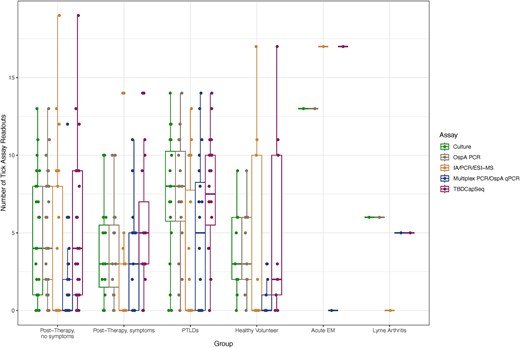
Results: Recovered ticks included 402 from post-therapy, 314 from PTLDS, 30 from the EM patient, 11 from the LA patient, and 80 from HV. All ticks tested negative for B. burgdorferi except for 1 tick from a recovered patient. An unplanned interim analysis led to the early termination of the study for futility.
Conclusion: Xenodiagnosis with larval I. scapularis ticks showed no evidence of B. burgdorferi in most patients after treatment, irrespective of symptoms. This may be due to absence of bacteria or to the low sensitivity of the technique in humans. This method is unlikely to detect persistent B. burgdorferi infection in humans and further research on the use of xenodiagnosis is unwarranted.
Keywords
Borrelia burgdorferi | Ixodes scapulari | Lyme disease | Post-Treatment Lyme Disease Symptoms | Xenodiagnosis
Posted by
Levy CIMAR