

The Brief Case: Adjudication of discrepant genotypic and phenotypic antimicrobial susceptibility testing results in a patient with Staphylococcus aureus bacteremia
Published
February 11, 2026
Source
Fabiola Reyes Curcio, Justin McCallum, Gina Borrelli, Beverley Orr, Zoe Weiss, E Zachary Nussbaum
J Clin Microbiol.
2026 Feb 11;64(2):e0080925.
PMID: 41670363
PMCID: PMC12893003
DOI: 10.1128/jcm.00809-25
Abstract
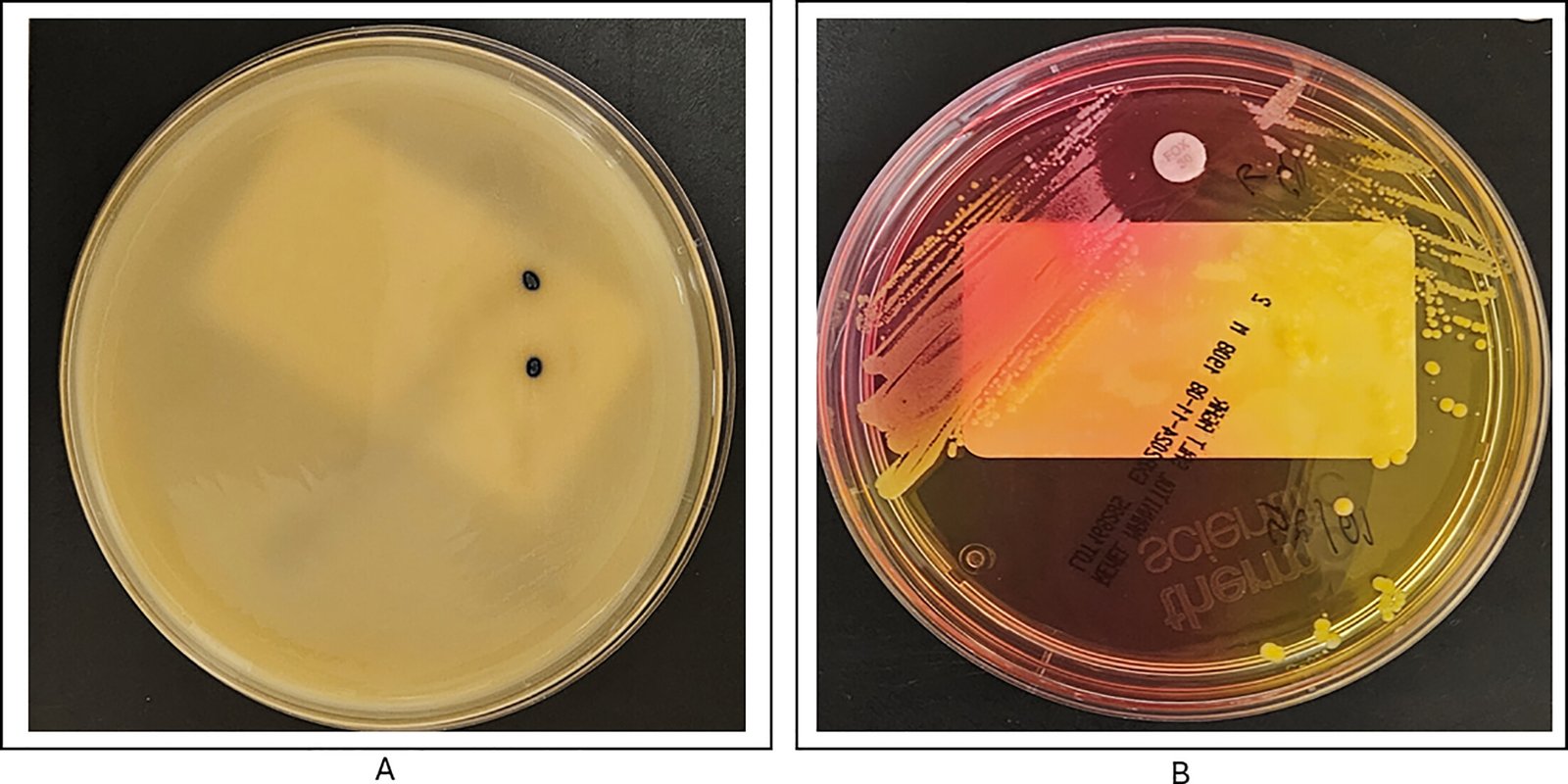
Case: A 41-year-old female with ongoing injection drug use and recent methicillin-susceptible Staphylococcus aureus (MSSA) bacteremia and lumbar epidural abscess requiring operative washout presented with lumbar wound dehiscence. The patient was taken back to the operating room for surgical debridement of the paraspinal infection and placement of extensive hardware for spinal stabilization. Operative cultures again grew MSSA. Two sets of peripheral blood cultures were obtained on admission. Three of four bottles turned positive, with Gram stain revealing gram-positive cocci in clusters in all three positive bottles. Multiplex PCR testing was performed directly on a positive blood specimen using the BioFire FilmArray blood culture identification 2 (BCID2) panel (bioMérieux, Marcy l’Etoile, France). Results were positive for S. aureus and Staphylococcus epidermidis. Both mecA/C and mecA/C + MREJ targets were detected, and the patient was initiated on vancomycin. Growth on solid media and subsequently matrix-assisted laser desorption/ionization-time of flight analysis confirmed the identification of S. aureus in all three bottles, as well as S. epidermidis in one bottle—the bottle on which initial BCID2 testing was performed. Since the mecA/C + MREJ target is specific for methicillin-resistant S. aureus (MRSA), it was expected that phenotypic antimicrobial susceptibility testing (AST) would confirm oxacillin resistance. However, AST performed on five well-isolated colonies of S. aureus from a subculture of each positive blood culture bottle using the VITEK 2 instrument demonstrated oxacillin (MIC = 0.5 μg/mL) and cefoxitin susceptibility in all S. aureus isolates and resistance only in the S. epidermidis isolate. This represented a clinically significant discrepancy between rapid molecular AST and conventional phenotypic AST. Further laboratory investigation was required.
Keywords
antibiotic start | antimicrobial stewardship | long-term care | nursing home | public health
Posted by
Levy CIMAR