

News
News
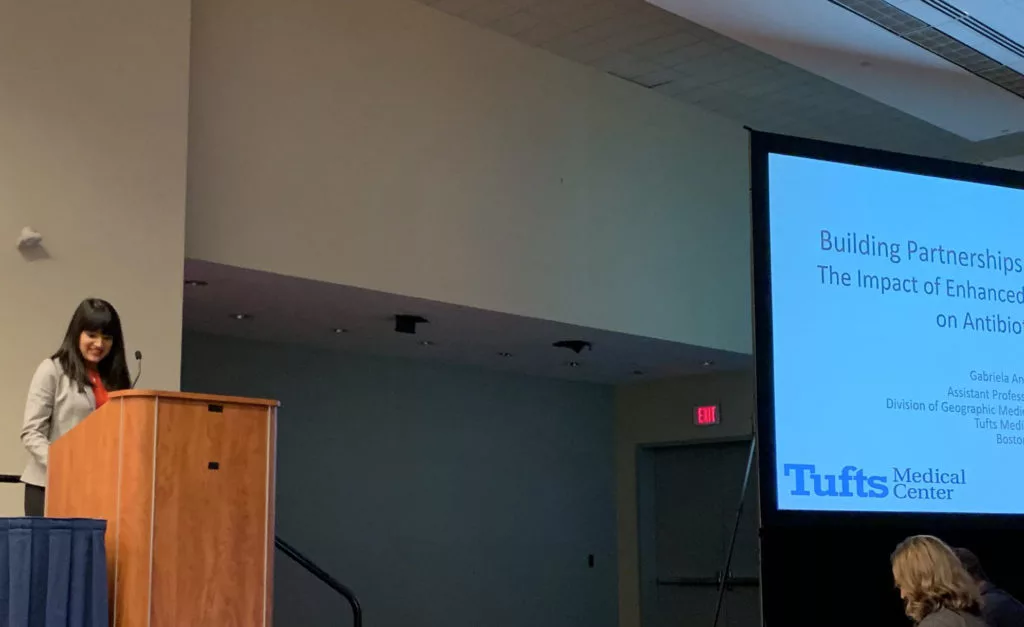
CIMAR LEAP Fellow Presents Groundbreaking Antimicrobial Stewardship Findings at IDWeek
Dr. Gabriela Andujar Vazquez presented groundbreaking findings from her antimicrobial stewardship pilot study at IDWeek in Washington, D.C. earlier this month. The study showed a 20% decrease in antibiotic start rate in patients, potentially demonstrating the benefit of enhanced stewardship support by an expert on antibiotic use in long term care.

News
Antibiotics Are Losing Their Power Against Deadly Infections. Can We Fix the Problem?
Experts say the problem of AMR is compounded by improper use of antibiotics by doctors, hospitals and patients, as well as by farmers and others in the agricultural sector (the drugs are commonly administered to livestock, as well as to humans). Check out this eye-opening panel discussion from CIMAR’s Dr. Helen Boucher and others.
News
ASM Podcast Honors the Life and Legacy of Dr. Stuart Levy
The TWiM holobionts pay tribute to Stuart Levy, and reveal the remarkably diverse array of cyclic nucleotides synthesized by bacteria that likely mediate interactions with animal and plant hosts. Dr. Levy’s friends and colleagues, Drs. Elio Schaechter and Michele Swanson, join the discussion.
News
Remembering Stuart Levy, a Pioneer Who Sounded the Alarm on the Threat of Antimicrobial Resistance
Stuart B. Levy, a key inspiration for CIMAR and an Emeritus Professor of Molecular Biology and Microbiology at the Tufts University School of Medicine, died following an extended illness on September 4th. Dr. Levy’s pioneering research and impassioned advocacy raised awareness of the danger of antibiotic resistance, He was 80. Colleagues, friends and family remember Dr. Levy in this piece from TuftsNow.
News
Why is there an EEE Vaccine for Horses but not for Humans?
Actually, there is a human vaccine for eastern equine encephalitis (EEE), but it has never been approved for public use. The U.S. Army Medical Research Institute of Infectious Diseases—the military medical research institute at Fort Detrick in Maryland—developed a human EEE vaccine in the mid-1980s. Tufts Cummings School Professor Sam Telford, an expert on infections spread by mosquitoes and ticks, explains.
News
Tufts Cummings Vet School Hosts Symposium on “Engaging Veterinarians to Advance Human and Animal Health”
Nearly 600 veterinary students from the U.S., Canada, and beyond attended the 30th National Veterinary Scholars Symposium, hosted by the Cummings School of Veterinary Medicine at Tufts University. The meeting featured topics on critical care, antimicrobial resistance, regenerative medicine, cancer biology, infectious diseases, and pathways to research career development.
News
New Antibiotic Approved for Drug-Resistant Tuberculosis
The Food and Drug Administration has approved a new drug for highly drug-resistant tuberculosis, the world’s leading infectious cause of death. The antibiotic, called pretomanid, was developed by a nonprofit group called TB Alliance at a time when few companies are investing in the expensive and unprofitable endeavor of creating next-generation antibiotics. CIMAR Director Dr. Helen Boucher shares her insights.
News
Tufts Researchers Focus on Mice as Potential Solution to Lyme Disease
New England has some of the highest rates of Lyme disease in the country. In 2017, there were more than 400 confirmed and probable cases in Massachusetts. In Maine, the number of confirmed and probable cases was more than 1,800. Now, a unique project aims to stop the disease in its tracks by going straight to the source.
News
Automatically Chlorinating Water Reduces Diarrheal Diseases in Children in Urban Bangladesh
“This novel, low-cost technology requires no behavior change or effort by users–safe water comes straight out of the tap,” says CIMAR’s Dr Amy Pickering, who led the research. “This point-of-collection approach to water treatment could be a transformative strategy for reducing gastrointestinal disease burden in low-income urban communities.”
News
Overdue Outbreak Detection System Leaves Patchwork Defense
According to CIMAR Director Dr. Helen Boucher and others, the U.S. should have had a nationwide network to monitor for the next viral outbreak or biological threat a decade ago. Instead, public health leaders make do with a patchwork system while waiting for the Department of Health and Human Services races to get its integrated network in service.
News
Call the Bee Vet: Bee Keepers Can No Longer Get Antibiotics Over the Counter
Shortly after the FDA directive mandating that any antibiotics for honeybees be prescribed by veterinarians, Tufts Cummings School offered a sold-out continuing-education bee medicine workshop for practicing veterinarians. Tufts hopes to offer more training for veterinarians in the near future.
News
Antibiotics Developers Seek a Cure for Industry Ills
Not long ago, Achaogen Inc. was flying high. In early 2017, the drugmaker’s market capitalization soared above $1 billion on high hopes for its new medicine, an antibiotic targeting complicated urinary-tract infections. But in April—less than a year after the drug was approved by the Food and Drug Administration—Achaogen filed for bankruptcy.