

A Public Health Approach to Antimicrobial Stewardship in Long-Term Care Facilities: A Multifaceted Program in Massachusetts
Published
February 13, 2026
Source
Kap Sum Foong, Leslie Fowle, Amanda Slider, Maureen Campion, Jessica Leaf, Melissa Cumming, Barbara Bolstorff, Christina Brandeburg, Eileen McHale, Catherine Reilly, Kirthana Beaulac, Gabriela Andujar Vazquez, Benjamin Koethe, Shira Doron, Majd Alsoubani
Abstract
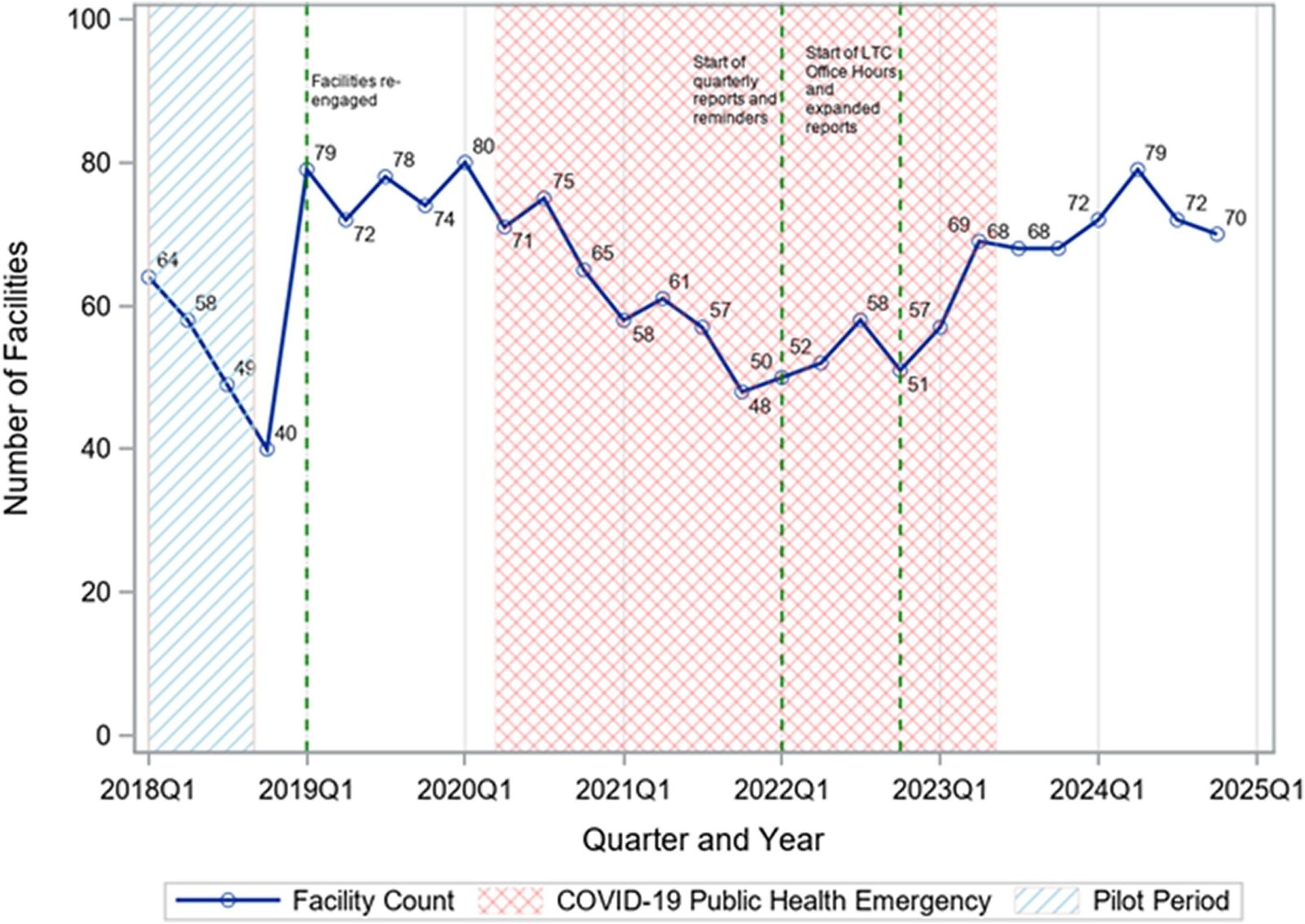
Background: Benchmarking is an effective strategy to improve antibiotic use but remains underutilized in long-term care(LTC). In 2018, the Massachusetts Department of Public Health, in partnership with Tufts Medical Center, launched the Antibiotic Start(AS) Reporting Program, a statewide initiative to monitor and improve antibiotic prescribing in LTC facilities through monthly reporting and feedback, alongside other stewardship interventions.
Methods: LTC facilities voluntarily submitted monthly AS data through an online platform. AS rates were calculated as AS per 1,000 resident-days. Quarterly benchmarking reports and educational activities(introduced in 2022), including LTC office hours webinars, were conducted to support interpretation and engagement. We conducted an interrupted time series(ITS) analysis to assess changes in beta-lactam and fluoroquinolone prescribing from 2018 to 2024, and a stratified analysis comparing AS rates between facilities with and without honor roll recognition.
Results: A total of 217 LTC facilities submitted ≥1 month of AS data. The overall AS rate rose 7%, from 7.22 to 7.70 per 1,000 resident-days. Fluoroquinolone starts decreased 36%, while beta-lactam starts increased 26%. ITS analysis showed a significant rise in beta-lactam use following the October 2022 expansion of benchmarking reports and LTC office hours(p<0.001). A subgroup analysis showed higher total and beta-lactam AS rates among honor roll facilities compared with non-recognized facilities.
Conclusions: The Massachusetts AS Reporting Program demonstrates that sustained, data-driven public health-academic collaboration can advance antimicrobial stewardship in LTC. By combining benchmarking, feedback, education, and recognition, public health agencies can support stewardship engagement and promote sustainable improvement in antibiotic use across resource-limited settings.
Keywords
antibiotic start | antimicrobial stewardship | long-term care | nursing home | public health
Posted by
Levy CIMAR