

Automatic discovery of clinically interpretable imaging biomarkers for Mycobacterium tuberculosis supersusceptibility using deep learning
Published
December 1, 2020
Source
Thomas E Tavolara, M Khalid Khan Niazi, Melanie Ginese, Cesar Piedra-Mora, Daniel M Gatti, Gillian Beamer, Metin N Gurcan
Abstract
Background: Identifying which individuals will develop tuberculosis (TB) remains an unresolved problem due to few animal models and computational approaches that effectively address its heterogeneity. To meet these shortcomings, we show that Diversity Outbred (DO) mice reflect human-like genetic diversity and develop human-like lung granulomas when infected with Mycobacterium tuberculosis (M.tb) .
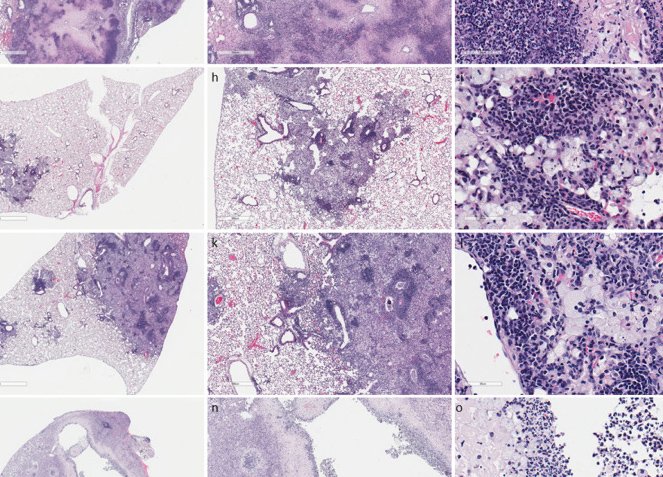
Methods: Following M.tb infection, a "supersusceptible" phenotype develops in approximately one-third of DO mice characterized by rapid morbidity and mortality within 8 weeks. These supersusceptible DO mice develop lung granulomas patterns akin to humans. This led us to utilize deep learning to identify supersusceptibility from hematoxylin & eosin (H&E) lung tissue sections utilizing only clinical outcomes (supersusceptible or not-supersusceptible) as labels.
Findings: The proposed machine learning model diagnosed supersusceptibility with high accuracy (91.50 ± 4.68%) compared to two expert pathologists using H&E stained lung sections (94.95% and 94.58%). Two non-experts used the imaging biomarker to diagnose supersusceptibility with high accuracy (88.25% and 87.95%) and agreement (96.00%). A board-certified veterinary pathologist (GB) examined the imaging biomarker and determined the model was making diagnostic decisions using a form of granuloma necrosis (karyorrhectic and pyknotic nuclear debris). This was corroborated by one other board-certified veterinary pathologist. Finally, the imaging biomarker was quantified, providing a novel means to convert visual patterns within granulomas to data suitable for statistical analyses.
Implications: Overall, our results have translatable implication to improve our understanding of TB and also to the broader field of computational pathology in which clinical outcomes alone can drive automatic identification of interpretable imaging biomarkers, knowledge discovery, and validation of existing clinical biomarkers.
Funding: National Institutes of Health and American Lung Association.
Posted by
Levy CIMAR