

Resistance, heteroresistance, and fitness costs drive colistin treatment failure during Acinetobacter baumannii pneumonia
Published
January 6, 2026
Source
Juan Hernandez-Bird, Bixi He, Leah M VanOtterloo, Elizabeth B Billings, Wenwen Huo, Gabriella I C Teodoro, Haley Echlin, Jason M Rosch, M Stephen Trent, Ralph R Isberg
Proc Natl Acad Sci U S A.
2026 Jan 6;123(1):e2515303123.
PMID: 41461032
Abstract
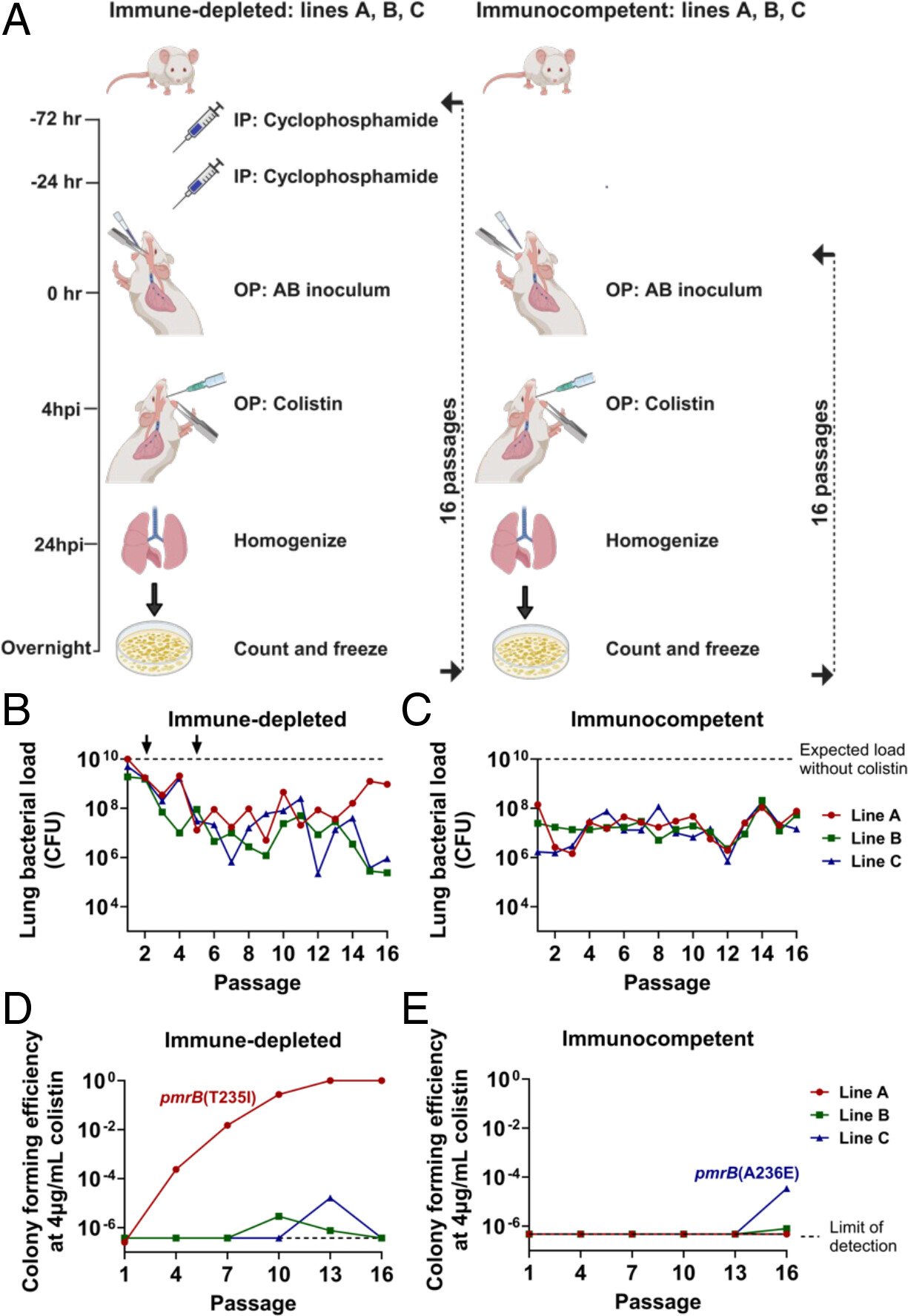
Acinetobacter baumannii is an Enterococcus, Staphylococcus, Klebsiella, Acinetobacter, Pseudomonas, and Enterobacter species (ESKAPE) pathogen linked to healthcare-associated diseases. Due to evolved resistance, last-resort antibiotics such as the lipooligosaccharide (LOS)-targeting colistin are increasingly used to treat multidrug-resistant isolates. To track the evolution of colistin resistance within a host, we performed sequential oropharyngeal infections in immunocompetent or immune-depleted mice in the presence of inhaled colistin. Both resistant and heteroresistant A. baumannii strains emerged with pmrB mutations that efficiently competed with the susceptible parent in the presence of colistin. These pmrB mutants had a fitness cost in the absence of colistin treatment but retained their ability to colonize the host. In contrast, LOS-deficient A. baumannii mutants removed the target of colistin, but such mutants were unable to colonize the lung. The two pathogenic pmrB mutants showed clear evidence of LOS modification, which was linked to increased transcription of LOS modification enzymes, including the product of the cryptic eptA gene. Spontaneous insertion mutations that caused hyperexpression of eptA allowed the heteroresistant mutant to develop clinically significant colistin resistance. Insertion mutations upstream of the eptA gene or those disrupting hns, which encodes a small histone-like protein, resulted in increased eptA transcript, linking expression of this protein to clinically significant resistance. A resistant variant derived from the heteroresistant parent was stable in the absence of drug, but continued passaging selected for colistin-resensitized pseudorevertants that were largely due to disruption of the LOS modification enzymes. Therefore, colistin heteroresistance is an early stage in the stepwise acquisition of stable colistin resistance in A. baumannii.
Keywords
Acinetobacter baumannii | antibiotic resistance | immunocompetence | insertion sequences | pneumonia
Posted by
Levy CIMAR