

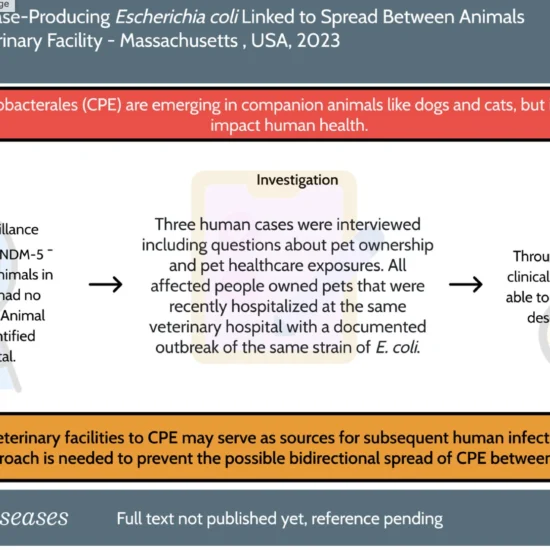
Human Cases of Carbapenemase-Producing Escherichia coli Linked to Spread Between Animals and the Environment in a Veterinary Facility -Massachusetts, USA, 2023
Published
Sept 26, 2025
Source
Ian M DeStefano, Claire L Fellman, Paula M Snippes Vagnone, Melissa A Cumming, Jennifer L Dale, Abbey Ruhland, Jaclyn Dietrich, Catherine M Brown, Esther Fortes, Nicolas N Epie, Amanda Beaudoin, Katherine Janiszewski, Jessica Leaf, Shira Doron, Matthew Doucette, Stephen D Cole
Abstract
Background: Carbapenemase-producing Enterobacterales (CPE), traditionally thought to cause hospital-acquired infection in humans, are now emerging as agents of both community-acquired infections in humans as well as hospital-acquired infections in pets. It is currently unknown what impact this spread amongst animals may have on human health.
Methods: The Massachusetts State Public Health Laboratory investigated links between three genetically-related human cases of blaNDM-5-harboring E. coli. Simultaneously, a separate, collaborative investigation into blaNDM-5-harboring E. coli animal infections at a Massachusetts veterinary hospital was conducted including animal and environmental screening. Whole genome sequencing (WGS) was performed on human, animal and veterinary hospital environmental isolates. Once a genetic link was established between animal and human isolates, follow-up interviews including questions related to pet exposure were performed with affected humans.
Results: WGS demonstrated that human, animal and veterinary environmental isolates clustered within 0-10 single nucleotide polymorphisms. Although initial case interviews failed to identify any epidemiologic linkages between the humans, follow-up questioning revealed that all three human cases had pets treated at the same veterinary hospital prior to their diagnosis.
Conclusions: This report suggests the potential for transmission of blaNDM-5-harboring E. coli between animals and people. There is an urgent need to invest resources and develop a One Health approach to support veterinary facilities in recognizing and preventing transmission of CPE to limit spread within communities. Physicians, veterinarians, and public health professionals conducting outbreak investigations should be aware of this potential route of CPE spread.
Keywords
Carbapenemase-producing Enterobacterales | Companion Animals | Public Health Investigation | whole-genome-sequencing | Zoonoses
Posted by
Levy CIMAR